

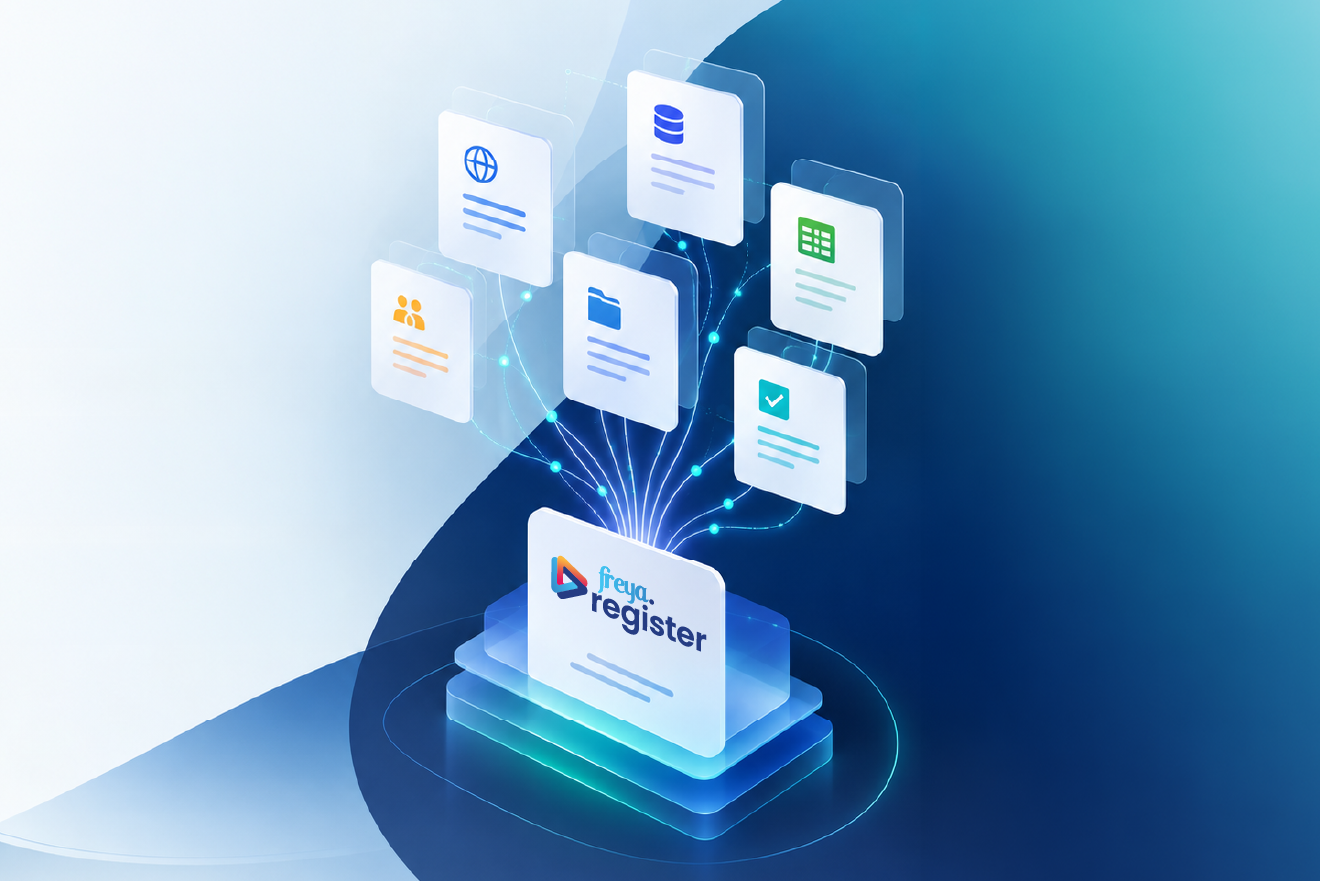
One product can generate six records across six systems, all of them correct locally, and none of them the same. The fix is not a better filing system.
How Regulatory Data Fragmentation Creates Six Records for One Product
A market updates one labelling requirement for one product. It is a small change, clearly worded, and it arrives on a Tuesday.
Six weeks later, the change has been entered into a spreadsheet, emailed to three regions, logged in two local trackers, clarified once, reconciled twice, and added to a deadline calendar that lives outside every system it refers to. All of that work was done carefully by people who know what they are doing.
And if you ask five of them which record is current, you will get five answers. All defensible. None the same.
This is not a story about a bad team or a broken system. It is a story about what happens when a product's regulatory story is held in six places and connected in none. And it is a story that gets more common, not less, as an organization grows. It compounds again when a product range spans more than one regulated category, because then the records do not simply disagree — they answer to different rulebooks.
Why Regulatory Data Fragmentation Is a Structural Problem, Not a Discipline Problem
It is tempting to read that scene as a failure of discipline. It is not. Each system in it was doing its job correctly. The regional tracker held the regional truth. The submission tool held the submission truth. The spreadsheet did exactly what the person who built it needed it to do. Every team followed a process, and every process was sound inside its own boundary.
The cost of this is not only money, though it is that too. It is that a dozen correct local decisions can add up to an incorrect global picture, and no amount of local diligence closes the gap.
That is the uncomfortable part. The fragmentation did not appear because someone was careless. It appeared because those careful, correct, local decisions had nothing connecting them. Each record was right where it sat, and the picture across them was still incoherent.
This matters because it tells you what will and will not fix it. Fragmentation is not a discipline problem. It is a structural one, and structure is not something a team can fix by trying harder. You can hire more diligent people, write tighter procedures, run more reconciliation meetings, and the six-records problem survives all of it, because none of those things changes the thing that produced it.
"Fragmentation is not a discipline problem. It is a structural one, and structure is not something a team can fix by trying harder."
The Three Layers of Regulatory Data Fragmentation
Look closely and the problem is not one thing. It is three, stacked, and each one sits on the one below.
At the base is regulatory data management itself. This is where growth does its quiet damage. As an organization expands into more markets, its regulatory function expands with it, and regional teams, left to grow organically, adopt their own systems of record because those systems solve the problem in front of them. The same product ends up being represented differently in different places, with no authoritative version, so the first question anyone asks, which record is current, has no single answer. That is the fragmented-data layer.
Rest the daily work on top of that and you get the second layer. Because the data does not agree with itself, the central team spends its time reconciling instead of progressing. A change captured in one region has to be found, re-entered, and checked everywhere else it lives, and someone has to confirm by hand that the version the centre holds is the version that is true. Whether it is product registration management across multiple countries or a single labelling update, the effort scales with the number of systems, not the size of the change. That is the inefficient-operations layer, and it is not a separate complaint. It is the direct cost of the first.
Put anything more ambitious on top, any attempt to ask harder questions of the data, and you meet the third layer. Whatever you try to do with the regulatory picture is only as good as the picture you can actually see, and the picture is scattered across systems that disagree. That is the limited-readiness layer, and it is not a technology gap. It is what the first two layers guarantee.
Each layer is the previous layer's consequence. That is why fixing the third one first never works. You cannot analyze your way out of data that does not agree with itself, and you cannot procedure your way out of a structure that was never connected. The order of the problem dictates the order of the fix.
What A Connected Product Record Means In Modern RIMS
If the problem is structural, the fix has to be structural too. So it is worth being precise about what connected means, because it is easy to say and easy to hollow out.
A connected product record is not one big system that swallows everything. It is the product master, its markets, its applications, its registrations, its documents, its obligations and its lifecycle events, the full span of regulatory lifecycle management, each held once, and, this is the part that carries the weight, the relationships between them treated as real, governed things in their own right.
That is the distinction that matters. In a fragmented estate, the objects exist but the relationships live in people's heads, in email threads, in the tacit knowledge of whoever has been there longest. Which registration this obligation affects, which document supports that submission, which markets this labelling change touches. Those links are the actual regulatory picture, and they are exactly what nothing owns today.
A connected record is not a bigger record. It is the relationships being first-class. When the link between a change and every record it touches is itself a governed object, the six-records problem cannot form, because there are no longer six disconnected answers to reconcile. There is one structure, and the question of which record is current stops being a question.
"A connected record is not a bigger record. It is the relationships being first-class."
Where Freya.Register sits
This is where a product belongs in the argument, and not before it.
Freya.Register is a regulatory information management system, RIM software for life sciences, built around exactly that idea: one governed core that holds a product's regulatory story and the relationships within it, with local records controlled rather than scattered. It forms the registration core of the Freya Fusion AI-First Regulatory Cloud.
The objection worth answering directly, because a reader in a mature ecosystem is already forming it, is this: am I being asked to move everything? No. The point of a connected core is not to replace the ecosystem you have. Your submission systems, your document systems, your ERP stay where they are and keep doing what they do well. What changes is not where those systems live. It is what they connect to, and whether the regulatory picture across them finally has a single place it is held together.
This is also the part that reframes what centralization means, and it is worth separating from a reorganization. The instinct, as a function matures, is to centralize the teams. But the regional nuance in regulatory work is real and cannot be designed away, because approval is a local act and local knowledge is what wins it. So the teams should stay where they are, close to their authorities. What centralizes is the data, not the desks. Connect the record and the operation is coordinated even while the people are distributed across the world. You get the coherence of a central function without dismantling the local expertise that made the function work in the first place.
That is also why this is easier to do earlier than later. A growing organization can build the connected record while the ecosystem is still small enough to connect. A larger one can still do it, and increasingly must, but it carries more to unlearn. The cost of waiting is not that the problem becomes unsolvable. It is that it becomes more expensive to solve.
Why Connected Regulatory Data Is More Than a Filing Question
It would be easy to file all of this under housekeeping. Tidy the data, run a cleaner operation, move on. That reading undersells it, but only slightly, and it is worth being honest about why.
The connected record earns its place on the six-records problem alone. That is the case, and it is complete without appealing to anything further. But it is worth saying plainly that whatever an organization chooses to ask of its regulatory data in the years ahead, including AI-powered regulatory data management, the answer will only ever be as good as the context underneath it. Fragmented context does not just limit visibility. It limits what can be done with the data at all. The connected record is not only a cleaner operation. It is the ground everything later has to stand on.
"Fragmented context does not just limit visibility. It limits what can be done with the data at all."
From a System of Record to a System of Intelligence
So the question underneath all of this is not the one it first appears to be.
It is not whether your RIMS software holds the records. Most systems hold the records. The question is whether it holds them together, whether the relationships that are the actual regulatory picture are governed, or left to reconciliation and memory.
A system of record can tell you what each system says. A system of intelligence can not only tell you what is true across all of them, but also pave the way for advanced insights that improve the quality and speed of decision making. The difference between the two is not a feature. It is whether the product's story is connected in the first place.
Frequently Asked Questions About RIMS Software
What is a regulatory information management system in life sciences?
A regulatory information management system, or RIMS, helps life sciences organizations manage regulatory information across products, markets and the product lifecycle. It brings product data, applications, registrations, submissions, documents, health authority commitments and lifecycle obligations into a governed structure.
How to choose RIMS software for life sciences?
Modern RIMS software should support regulatory data management, connect product and registration records across markets, provide traceability and integrate with document, submission and enterprise systems. A strong RIMS solution governs the relationships between records instead of creating another isolated repository.
How do RIMS tools support product registration and regulatory lifecycle management?
RIMS tools support product registration management by linking products and markets to applications, registrations, submissions, commitments and renewal or variation activities. This helps regulatory teams plan and track work across the regulatory lifecycle without rebuilding the picture in spreadsheets, which is what makes a RIMS true regulatory lifecycle management software.
How to fix regulatory data fragmentation in life sciences?
Regulatory data fragmentation is fixed by connecting the record, not by reconciling it. Reconciliation compares disconnected records after differences have already formed. It may identify inconsistencies, but it does not create the governed relationships needed to prevent them from recurring.
Why Modern RIMS Must Connect the Product Story
Modern RIMS cannot solve regulatory data fragmentation or create a reliable global view by storing more disconnected records. It must connect the product, market, application, registration, document, obligation and lifecycle relationships that make those records meaningful. That is what turns reconciliation-heavy regulatory information management into a governed foundation for faster, more confident decisions.
Start by asking whether your current RIMS can show one trusted product story across every market. If the answer still depends on spreadsheets, email or individual memory, the next step is not another reconciliation cycle. It is to connect the record.
Are you looking to convert your system of record to a system of intelligence?
Freya.Register — The RIMS Built for Intelligence.